In a tadpole construction, the rope forms the compressible internal core. The outer textile wraps around that core to create the sealing bulb, while an extended fabric tail provides a dedicated mounting area.
This distinction is important when sourcing replacement seals for industrial oven doors, furnace access panels, boilers, kilns and thermal processing equipment. Ordering only by the words “fiberglass rope” or “gasket rope” may result in a completely different profile from the original seal.
BSTFLEX manufactures custom tadpole gaskets and tadpole seals with different textile covers, fiber cores and metallic core constructions for OEM and replacement applications.
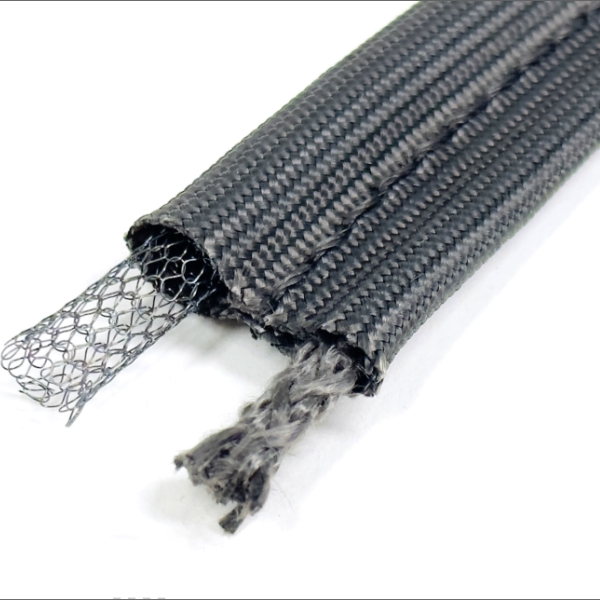
A rope core tadpole gasket contains a flexible textile rope inside the bulb section of the gasket.
The rope performs a different function from the outer cover:
| Component | Function |
|---|---|
| Outer Cover | Forms the external textile surface and encloses the core. |
| Rope Core | Provides the internal body, compression and support for the bulb. |
| Bulb | Creates the primary compression sealing area. |
| Tail | Provides the mounting section for mechanical retention. |
The rope itself may be braided, twisted, knitted or produced using another fiber construction depending on the application and manufacturing specification.
For this reason, “rope core” is more precise than simply stating “fiber core” when the internal construction is actually manufactured as a rope.
A standard gasket rope and a rope-core tadpole gasket can use similar fibers, but their geometry and installation methods are different.
| Feature | Rope Core Tadpole Gasket | Standard Gasket Rope |
|---|---|---|
| Profile | Bulb plus integrated mounting tail | Round, square or rectangular rope |
| Core | Rope is enclosed inside the bulb | The rope itself is the finished seal |
| Mounting | Tail can be mechanically retained | Usually installed directly into a channel, groove or joint |
| Compression Zone | Defined by the bulb profile | Defined by the rope cross-section |
| Typical Use | Doors, access panels and removable covers | Grooves, channels, stove doors, flanges and general joints |
If the original equipment uses a flat fabric tail attached to a rounded sealing bulb, it should normally be specified as a tadpole gasket rather than as loose gasket rope.
A fiberglass rope core tadpole gasket uses fiberglass rope inside the sealing bulb.
This construction provides a non-metallic internal structure with useful flexibility and compressibility. The exact behavior depends on rope diameter, fiber construction, density and the way the outer cover is sewn around the core.
Fiberglass rope core can be considered where the gasket needs:
BSTFLEX already uses a fiberglass rope core in the PTFE Coated Fiberglass Cover Fiberglass Core Tadpole Gasket . In this construction, the rope forms the internal bulb while the PTFE-coated fiberglass forms the exposed working surface.
These terms should not automatically be treated as identical.
A fiberglass fiber core describes the material family but may not tell the buyer how the internal structure is produced. A fiberglass rope core specifically indicates that the bulb contains a rope-form construction.
For replacement work, ask:
These details can influence closing force and compression behavior even when two finished bulbs have similar outside dimensions.
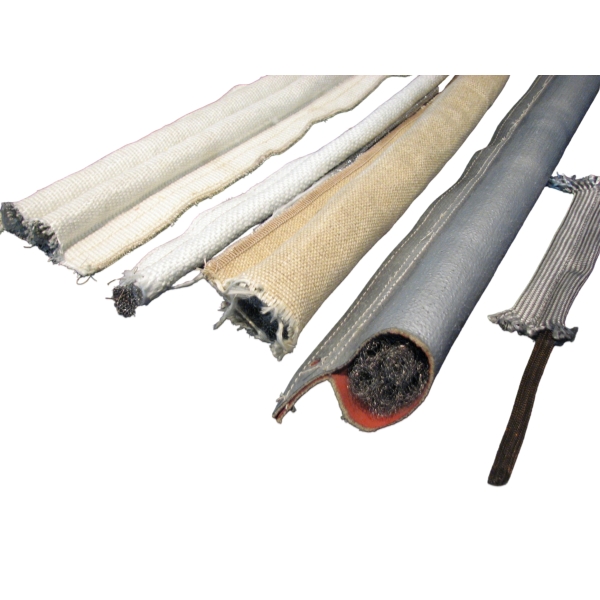
A silica rope core tadpole gasket uses a silica-based rope inside the bulb.
This type of core can be considered for applications requiring a higher-temperature fiber construction than conventional fiberglass, provided that the complete gasket cover, stitching and other components are also suitable for the operating environment.
Silica rope can be paired with a suitable high-temperature cover depending on the required thermal and mechanical conditions.
When specifying this type of gasket, do not assume that a silica core automatically makes the complete gasket suitable for the maximum published temperature of the raw silica fiber. The final assembly must be evaluated as a system.
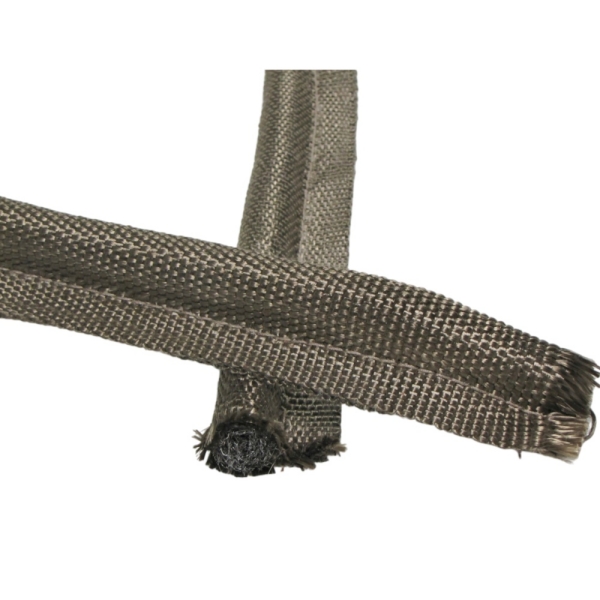
A ceramic rope core tadpole gasket uses a high-temperature ceramic fiber rope inside the bulb.
It can be considered for demanding furnace, kiln and heat-treatment applications where the core itself needs to be based on a high-temperature fiber material.
Important specification details include:
Do not describe every ceramic fiber core as a ceramic rope core unless the internal component is actually made in rope form.
Rope core and metallic mesh core constructions serve different mechanical requirements.
| Characteristic | Rope Core | Metal Mesh Core |
|---|---|---|
| Internal Material | Fiberglass, silica, ceramic or other textile rope | Stainless steel or Inconel mesh |
| Metal Content | Normally non-metallic unless rope is reinforced | Metallic |
| Compression | Depends heavily on rope density and construction | Depends on mesh density, wire size and core geometry |
| Mechanical Support | Provided by the fiber rope | Provided by the metallic mesh structure |
| Selection Reason | Flexible fiber-based bulb construction | Metallic reinforcement and application-specific resilience |
BSTFLEX also manufactures stainless steel core tadpole gaskets and hollow stainless steel core tadpole gaskets for applications where a metallic core is preferred.
The material name alone does not determine how a rope-core bulb behaves.
A loosely constructed rope can deform differently from a dense braided rope of the same nominal diameter. The surrounding textile cover also influences the finished bulb because it limits expansion and controls the final profile.
For OEM applications, important variables can include:
If compression force is critical, evaluate the finished gasket rather than relying only on the specification of the internal rope.
The rope diameter is not necessarily the same as the final outside diameter of the tadpole bulb.
The outer cover, folds, seams and construction method all contribute to the final gasket dimensions.
A complete size specification should therefore include:
| Dimension | What to Specify |
|---|---|
| Core Diameter | Nominal rope diameter inside the bulb, where known |
| Bulb Height | Free outside height in the compression direction |
| Bulb Width | Free outside width across the bulb |
| Tail Width | Mounting width measured from defined reference points |
| Tail Thickness | Finished textile thickness in the retained section |
| Overall Width | Total cross-sectional width of the finished gasket |
| Finished Length | Required cut length or finished perimeter |
This distinction is especially important when replacing an existing gasket.
For example, a rope may sit inside several layers of fabric, making the finished outside bulb larger than the nominal rope diameter. A worn bulb can also appear smaller after long-term compression.
When preparing a replacement RFQ, identify whether the dimension refers to:
Do not use these dimensions interchangeably.
A used gasket should be treated as reference evidence rather than as a perfect representation of the original new profile.
Before selecting the replacement, record:
If the old rope core has become permanently compressed, matching its current size may produce an undersized replacement.
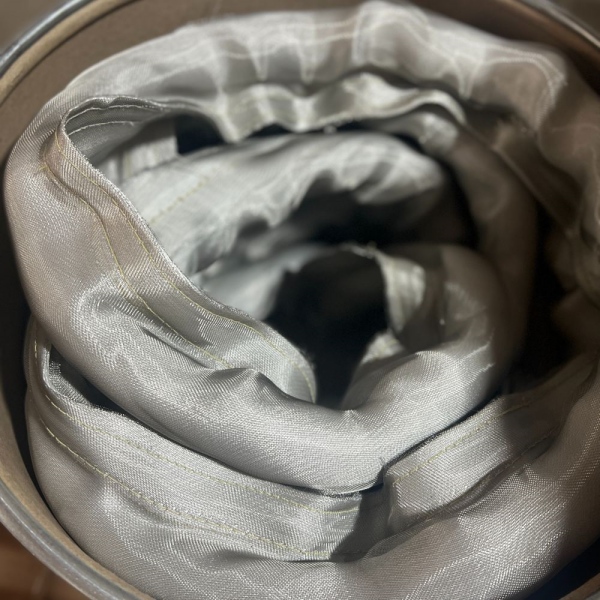
A white or off-white textile core may be fiberglass, silica, ceramic fiber or another material. Visual inspection alone is not sufficient to confirm fiber composition or temperature capability.
Use the original technical specification where available. If the original construction is unknown, provide the application conditions and mark the material as unknown instead of assigning an assumed specification.
Rope-core tadpole gaskets are useful around industrial oven doors where a flexible bulb needs to maintain contact around the perimeter while the tail remains mechanically retained.
Typical considerations include:
Fiberglass rope core may be a practical option where the temperature and mechanical conditions suit a fiber-based construction.
For furnaces and kilns, the actual temperature at the gasket location should be established before choosing fiberglass, silica or ceramic rope.
Higher-temperature core material does not automatically solve problems caused by:
The cover, core, stitching and mounting system should all be reviewed together.
Boiler access doors and inspection panels can also use bulb-and-tail seals where the equipment design requires a compressible perimeter gasket with a mechanically retained tail.
For these applications, provide operating temperature, pressure conditions, door geometry and any leakage requirement with the RFQ.
A textile tadpole gasket should not automatically be described as pressure-rated or gas-tight without appropriate system validation.
A rope core may be preferred where the design calls for a flexible textile-based internal structure without a metallic mesh.
A hollow metal core may be more appropriate where an open-center metallic structure and different recovery characteristics are required.
The decision should be based on actual compression and closing-force requirements rather than assuming one construction is universally softer or better.
For OEM and replacement projects, BSTFLEX can evaluate different combinations of:
Custom manufacturing can begin from a cross-sectional drawing, dimensional specification or existing sample.
For broader OEM development options, review the BSTFLEX Custom Tadpole Gasket Manufacturer page.
| RFQ Item | Information Needed |
|---|---|
| Equipment | Industrial oven, furnace, kiln, boiler, duct, damper or other application |
| Cover | Fiberglass, silica, ceramic, coated fiberglass or unknown |
| Rope Core | Fiberglass, silica, ceramic or unknown |
| Core Construction | Braided, twisted, knitted or unknown |
| Core Diameter | Nominal rope diameter if known |
| Bulb Size | Finished bulb height and width |
| Tail | Width, thickness and mounting arrangement |
| Gap | Closed sealing gap and variation around the perimeter |
| Temperature | Continuous and maximum temperature at the gasket location |
| Length | Cut length or finished perimeter dimensions |
| Quantity | Prototype and production quantity |
| Reference | Drawing, photographs or existing gasket sample |
The term generally refers to a tadpole gasket that uses a rope-form core inside its compressible bulb. The finished gasket still includes a textile cover and mounting tail, so it is different from ordinary loose gasket rope.
Depending on the required construction, rope cores can include fiberglass, silica or ceramic fiber. The correct material depends on operating temperature, compression requirements and the complete gasket design.
Not necessarily. Fiberglass can refer to the outer cover, the internal core or both. The RFQ should identify the cover and core separately.
A metallic mesh core can be used in some designs, but it should not automatically be treated as a direct substitute. The two constructions can have different compression, recovery and mechanical characteristics.
Record the finished bulb height and width, tail dimensions, overall profile width and installed gap. If the rope diameter is known, record it separately from the finished bulb diameter.
Yes. Rope material, bulb dimensions, tail width, cover construction and finished length can be evaluated according to drawings, samples and application requirements.
BSTFLEX manufactures custom rope core tadpole gaskets, tadpole seals and high-temperature gasket profiles for industrial equipment.
For an existing application, send the gasket cross-section, bulb and tail dimensions, closed gap, operating temperature and available sample information.
For new OEM equipment, provide the joint drawing, required compression space, cover preference, rope core material and projected quantity.
Contact BSTFLEX for a custom rope core tadpole gasket quotation.

 English
 Deutsch
 русский
 italiano
 español
 português
 Nederlands
 العربية
 日本語
 한국의
 Türkçe
 Polski
 Tiếng Việt
 slovenský
 Indonesia